Showing posts with label waseeem. Show all posts

GSX1250FA

We're so used to the idea of sports tourer motorcycles costing upwards of £12,000 that it's a shock when a decent one comes along at a cheaper price.
At £7,120, Suzuki's new GSX1250FA saves more than £5,000 against bikes in the same class. Indeed, it's almost exactly half the price of Yamaha's FJR1300, which doesn't even boast the electronic sophistication of Ducati's Multistrada to justify the tag.
Suzuki has achieved this by taking the big-hearted Bandit 1250, making some relatively minor changes and, er, that's it. The question arising then is whether the resulting GSX1250FA is only half the motorcycle of its rivals.
Absolutely not; in some ways it manages to better them. It doesn't take long to list the changes in full: most obvious is the full fairing, a conservatively shaped piece of bodywork with a GSX-R-style headlight.
The front suspension has slightly firmer springs and damping to deal with the additional weight, and tucked inside the cockpit is a more modern, sportier dash with gear-position indicator and gear-change warning light.
Suzuki's All New GSX1250FA
2010 Suzuki Bandit GSX1250FA ABSBack to 2010 Suzuki Motorcycle Index Page
Click photos to enlarge.
They make great desktop images.
2010 Suzuki Bandit GSX1250FA ABS

• 2010 Suzuki Bandit GSX1250FA ABS
2010 Suzuki Bandit GSX1250FA ABS
The perfect NEW bike for both Sport and Touring Adventures


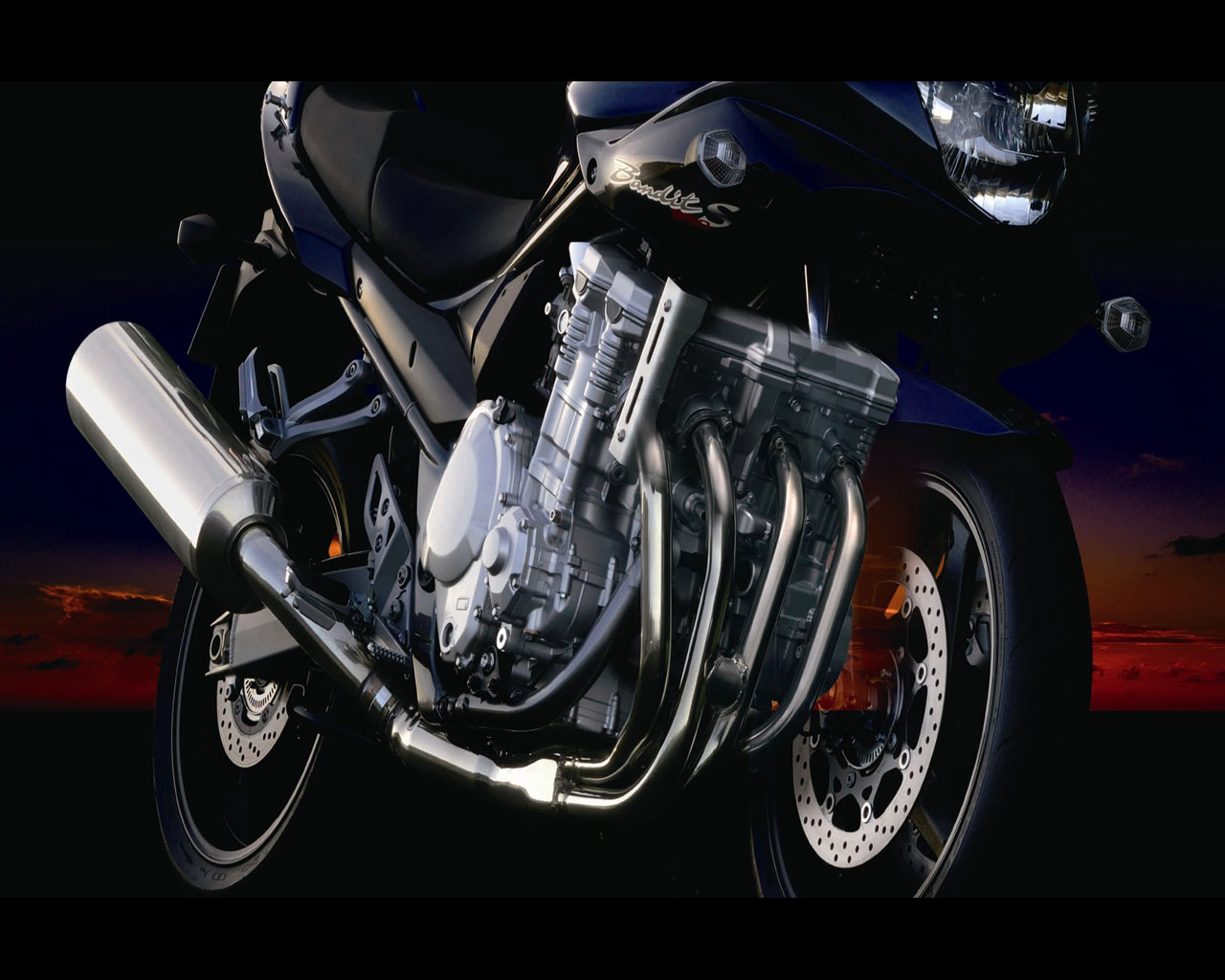
Featuring a distinctive sport-styled fairing, the GSX1250FA leads the way in styling, just as it leads the way in all-round sporty performance and unmatched value. The functional full fairing, housing vertically stacked multi-reflector halogen headlights expresses a neat, well-integrated styling impression with the fuel tank and the tail section. And with a full 1255cm3 of torque-producing displacement, the powerplant is tailored to a wide-ranging riding application, generating peak torque from relatively low in the rev range.
For those looking for a capable long distance companion, the GSX1250SEA Touring Edition is just what the doctor ordered. Complete with colour matching removable side an top hard bags, touring windshield and chromed bar end weights, the 1250SEA takes you and all your belongings there in style and comfort.
The GSX1250FA. All-round performance and user-friendly sport touring style.


Key Features
ABS Braking - 310mm dual front disc brakes with four piston calipers along with a 240mm rear disc and single piston caliper. Anti-Lock Braking (ABS) is also available and monitors wheel speed and matches braking power to available traction.
Instruments - Analog tachometer, LCD digital speedometer, LCD fuel gauge and clock, and LED indicator lamps.
Compact engine design with a central cam chain, staggered transmission shafts, tighter spacing between the pairs of cylinders and a secondary balancer shaft for reduced vibration
Centre Stand Equipped - Easy-to-operate centerstand with high leverage ratio to reduce effort
Adjustable Seat Height - Innovative seat height adjustment system can be adjusted up or down by 20mm with a simple spacer seat mounting system.
Suzuki Dual Throttle Valve fuel injection system featuring 36mm throttle bodies for optimum performance and smooth accelerations


Features and Benefits:
Engine Features

A catalyzer equipped high-volume muffler combined with an effective engine management system, Suzuki PAIR system, and oxygen sensor for reduced emissions meeting tough Euro 3 standards

Compact engine design with a central cam chain, staggered transmission shafts, tighter spacing between the pairs of cylinders and a secondary balancer shaft for reduced vibration
Cylinder head featuring 31mm exhaust valves and 27mm intake valves set at a narrow 16-degree valve angle
Hydraulic clutch with coil springs for improved lever feel and control
Liquid cooled oil cooler for reduced oil temperatures
Liquid-cooled, fuel injected, DOHC engine featuring a bore and stroke of 79.0mm x 64.0mm for a full 1255cc of torque-producing performance
Secondary balancer shaft for smooth engine operation
Suzuki Composite Electrochemical Material (SCEM) plating on cylinders is durable and efficient
Suzuki Dual Throttle Valve fuel injection system featuring 36mm throttle bodies for optimum performance and smooth accelerations
Suzuki Idle Speed Control (ISC) system for improved cold starting, consistent idle control and reduced emissions

Chassis Features
310mm dual front disc brakes with four piston calipers along with a 240mm rear disc and single piston caliper. Anti-Lock Braking (ABS) is also available and monitors wheel speed and matches braking power to available traction.
43mm front forks combined with a single rear shock with preload adjustability for riding with or without passengers
A slick shifting six speed transmission improves acceleration while reducing top gear rpm at highway speeds
Analog tachometer, LCD digital speedometer, LCD fuel gauge and clock, and LED indicator lamps.
Anti-Lock Braking (ABS) monitors wheel speed and matches braking power to available traction.
Cast three spoke aluminum wheels carrying radial tires and a standard easy-to-use centerstand
Easy-to-operate centerstand with high leverage ratio to reduce effort
Innovative seat height adjustment system can be adjusted up or down by 20mm with a simple spacer seat mounting system.

The GSX1250FA ABS features a sleek half fairing, with built in line-beam headlights, an effective windscreen and fairing mounted mirrors


Tube frame chassis featuring larger diameter down tubes for optimum torsional rigidity designed for excellent balance of sporty handling and comfortable highway cruising

Wide, comfortable seat with low seat height


2010 Suzuki Bandit GSX1250FA ABS - USA SpecificationsMSRP: $TBA USD
TBA


2010 Suzuki Bandit GSX1250FA ABS - Canada SpecificationsMSRP: $11,799 CDN
Chassis:
Brakes Front Disc brake, twin, ABS assisted
Brakes Rear Disc brake, ABS assisted
Colour Black, Blue
Curb Weight 257 kg (567 lbs)
Final Drive Chain
Fuel Tank Capacity 19 L (4.18 Imp gal)
Ground Clearance 135 mm ( 5.3 in)
Overall Length 2130 mm (83.9in)
Overall Width 790 mm (31.1 in)
Seat Height 805/825 mm (31.7/32.5 in) - Low/High
Suspension Front Telescopic, coil spring, oil damped
Suspension Rear Link type, coil spring, oil damped
Tires Front 120/70ZR17M/C (58W), tubeless
Tires Rear 180/55ZR17M/C (73W), tubeless
Transmission 6-speed constant mesh
Wheelbase 1485 mm (58.5 in)

Engine:
Bore Stroke 79.0 mm (3.110 in) x 64.0 mm (2.520 in)
Compression Ratio 10.5 : 1
Engine 1255 cc (76.6 cu. in), 4-stroke, liquid-cooled, DOHC
Fuel System Fuel injection
Ignition Electronic ignition (Transistorized)
Lubrication Wet sump
Starter Electric

Warranty:
Warranty 12 Month unlimited mileage limited warranty

2010 Suzuki GSX1250FA ST'
2010 Suzuki GSX1250FA ST picture
2010 Suzuki GSX1250FA ST image


2011 Suzuki GSX1250FA

2011 Suzuki GSX1250FA - Front Angle
Do you dare try to force GSX1250FA 2011 Suzuki motorcycle racing in the arena of race? dynamic and sporty look capable of binding all the people who look at it, on the front looks like a racing bike with full fairing with wind shield glass interesting. On the machine is not doubt, The GSX1250FA is powered by a compact, liquid-cooled, fuel-injected, 1255cc, DOHC, That wet sump engine has a bore and stroke of 79.0 mm x 64.0 mm. A secondary balancer shaft enhances the engine’s smooth operation. so the engine feels smooth and comfortable ride. In this motor is also equipped with a Digital Antilock Brake System (ABS) * That monitors wheel speed and matches stopping power to available traction. If you are interested, please come and take home this bike is priced at $ 11.599 USD
2011 Suzuki GSX1250FA - Left Angle


Suzuki GSX1250FA 2010

TOYOTA

   he history of Toyota started in 1933 with the company being a division of Toyoda Automatic Loom Works devoted to the production of automobiles under the direction of the founder's son, Kiichiro Toyoda.


Kiichiro Toyoda had travelled to Europe and the United States in 1929 to investigate automobile production and had begun researching gasoline-powered engines in 1930. Toyoda Automatic Loom Works was encouraged to develop automobile production by the Japanese government, which needed domestic vehicle production partly due to the worldwide money shortage and partly due to the war with China.In 1934, the division produced its first Type A Engine, which was used in the first Model A1 passenger car in May 1935 and the G1 truck in August 1935. Production of the Model AA passenger car started in 1936. Early vehicles bear a striking resemblance to the Dodge Power Wagon and Chevrolet, with some parts actually interchanging with their American originals.Although the Toyota Group is best known today for its cars, it is still in the textile business and still makes automatic looms, which are now computerized, and electric sewing machines which are available worldwide.

Toyota Motor Co. was established as an independent and separate company in 1937. Although the founding family's name is Toyoda , the company name was changed in order to signify the separation of the founders' work life from home life, to simplify the pronunciation, and to give the company a happy beginning. Toyota  is considered luckier than Toyoda  in Japan, where eight is regarded as a lucky number, and eight is the number of strokes it takes to writeToyota in katakana.

During the Pacific War (World War II) the company was dedicated to truck[citation needed]production for the Imperial Japanese Army. Because of severe shortages in Japan, military trucks were kept as simple as possible. For example, the trucks had only one headlight on the center of the hood. The war ended shortly before a scheduled Allied bombing run on the Toyota factories inAichi.
TOYOTA CARS


TOYOTA 2020 CAR

Lotus Engineering demonstrates the lightweight future of the passenger car

Study by Lotus Engineering concludes that a vehicle mass improvement of 38% versus a conventional mainstream vehicle can be achieved at only 3% cost.
Efficient design and lightweight materials significantly reduce CO2 emissions.

Lotus Engineering has c

onducted a study to develop a commercially viable mass reduction strategy for mainstream passenger vehicles. This study, released by the International Council on Clean Transportation, focused on the use of lightweight materials and efficient design and demonstrated substantial mass savings. When compared with a benchmark Toyota Venza crossover utility vehicle, a 38% reduction in vehicle mass, excluding powertrain, can be achieved for only a 3% increase in component costs using engineering techniques and technologies viable for mainstream production programmes by 2020. The 2020 vehicle architecture utilises a mix of stronger and lighter weight materials, a high degree of component integration and advanced joining and assembly methodologies.

Based on U.S. Department of Energy estimates, a total vehicle mass reduction of 33% including powertrain, as demonstrated on the 2020 passenger car model, results in a 23% reduction in fuel consumption. This study highlights how automotive manufacturers can adopt the Lotus philosophy of performance through light weight.
Dr Robert Hentschel, Director of Lotus Engineering said: "Lighter vehicles
are cleaner and more efficient. That philosophy has always been core to Lotus' approach to vehicle engineering and is now more relevant than ever. Lightweight Architectures and Efficient Performance are just two of our core competencies and we are delighted to have completed this study with input from the National Highway Traffic Safety Administration and the U.S. Environmental Protection Agency to provide direction for future CO2 reductions. We believe that this approach will be commonplace in the industry for the future design of vehicles."

The study investigated scenarios for two distinct vehicle architectures appropriate for production in 2017 and 2020. The near-term scenario is based on applying industry leading mass reducing technologies, improved materials and component integration and would be assembled using existing facilities. The mass reduction for this nearer term vehicle, excluding powertrain, is 21% with an estimated cost saving of 2%.

A benchmark Toyota Venza was disassembled, analysed and weighed to develop a bill of materials and understand component masses. In developing the two low mass concepts, Lotus Engineering employed a total vehicle mass reduction strategy utilising efficient design, component integration, materials selection, manufacturing and assembly. All key interior and exterior dimensions and volumes were retained for both models and the vehicles were packaged to accommodate key safety and structural dimensional and quality targets. The new vehicles retain the vision, sight line, comfort and occupant package of the benchmarked Toyota Venza.

Darren Somerset, Chief Executive Officer of Lotus Engineering Incorporated, Lotus' North American engineering division which led the study, said "A highly efficient total vehicle system level architecture was achieved by developing well integrated sub-systems and components, innovative use of materials and process and the application of advanced analytical techniques. Lotus Engineering is at the forefront of the automotive industry's drive for the reduction in CO2 and other greenhouse gas emissions and this study showcases Lotus Engineering's expertise and outlines a clear roadmap to cost effective mass efficient vehicle technologies."

The full report, entitled 'An Assessment of Mass Reduction Opportunities for a 2017 – 2020 Model Year Vehicle Program' can be found at the following link: http://www.theicct.org/documents/0000/1430/Mass_reduction_final_2010.pdf

The 2020 Passenger Car Technical Detail Body The body includes the floor and underbody, dash panel assembly, front structure, body sides and roof assembly. The baseline Toyota Venza body- in-white contained over 400 parts and the revised 2020 model reduced that part count to 211. The body-in-white materials used in the baseline Venza were 100% steel, while the 2020 model used 37% aluminium, 30% magnesium, 21% composites and 7% high strength steel. This reduces the structure mass by 42% from 382 kg to 221 kg.

The low mass 2020 body-in-white would be constructed using a low energy joining process proven on high speed trains; this process is already used on some low volume automotive applications. This low energy, low heat friction stir welding process would be used in combination with adhesive bonding, a technique already proven on Lotus production sports cars. In this instance, the robotically controlled welding and adhesive bonding process would be combined with programmable robotic fixturing, a versatile process which can be used to construct small and large vehicles using the same equipment.
Closures/Fenders

The closures include all hinged exterior elements, for example, the front and rear doors and the rear liftgate. One alternative approach included fixing the primary boot section to improve the structure, reduce masses and limit exposure to high voltage systems. A lightweight access door was provided for checking and replacing fluids.

The closures on the baseline Toyota Venza were made up of 100% steel. The low mass Venza closures/fenders would be made up of 33% magnesium, 21% plastic, 18% steel, 6% aluminium with the other 22% consisting of multiple materials. The mass savings are 41%, a reduction from 143 kg to 84 kg.

Interior

The interior systems consist of the instrument panel, seats, soft and hard trim, carpeting, climate control hardware, audio, navigation and communication electronics, vehicle control elements and restraint systems. There is a high level of component integration and electronic interfaces replace mechanical controls on the low mass model. For the 2020 model the instrument panel is eliminated replaced by driver and passenger side modules containing all key functional and safety hardware. A low mass trim panel made from a high quality aerated plastic closes out the two modules. The air conditioning module is incorporated into the console eliminating the need for close out trim panels; heated and cooled cupholders are integrated into the HVA/C module. The audio/HVA/C/Navigation touch screen contains the shifter and parking brake functions and interfaces with small electric solenoids. This eliminates conventional steel parking brake and shifter controls and cables as well as freeing up interior space.

The front seats mount to the structural sill and tunnel structure eliminating conventional seat mounting brackets (10 kg) and the need to locally reinforce the floorpan. The composite front seat structure utilises proven foam technology; the seat mass is reduced by up to 50%. The rear seat support structure is moulded into the composite floorpan eliminating the need for a separate steel support structure. The front and rear seats use a knit to shape fabric that eliminates material scrap and offers customers the opportunity to order their favourite patterns for their new vehicle. Four removable carpet modules replace the traditional full floor carpeting; this reduces mass and allows cost effective upgrading of the carpet quality. The floorpan is grained in all visible areas. The 2017 production interior mass was reduced from 250 kg to 182 kg with projected cost savings of 3%. The 2020 production interior mass was 153 kg with projected cost savings of 4%.


Top 10 Electric Cars

1. Tesla Roadster

If you have enough money and you are a passionate car collector then hurry up for this “Green Device” as the production is limited. This marvelous two seater with 6’831 laptop batteries costs about $100’000. The waiting list for next year is already full. This fast road machine can zip from 0-60 km/h in just 3.9 seconds, shockingly pulling a weight of 2’700 pound of vehicle itself beside passengers. The only problem yet is its one gear transmission, thus reducing acceleration to 5.9 seconds. But Tesla Motors are looking forward to redesign technology to overcome current short comings.

2. Toyota Plug-in Hybrid

Actually Toyota Motors is still on the roads to develop an advanced version of their own famous “Prius”. The name of the upcoming New Electric car is not yet announced by manufacturers so they call it as Plug-in hybrid term. They have a clear sketch of the futuristic car called Toyota Hybrid-X and their firm plans suggest its completion by 2010.


Special workings are done on Lithium-Ion batteries near to the one are used widely in laptop computers. On-board gasoline engine is installed similarly as well. But expectations from this electric car are so high as to beat the record of plug-in Prius’s i-e 62 miles on batteries. So, guys tight up your seat belts to welcome this vehicle.
Plug-in Toyota Prius can run good 10 miles just on batteries alone. The price is not formally announced but are expected around $28’000 to 30’000.

3. Chevy Volt

Chevy volt is fortunately making good name in auto market and people from all around the world, especially US customers are impatient to see it running on roads. This 4 seated Sedan of General Motors is an outstanding work of engineering and technology. This product will cost around $30’000 each which is pretty reasonable. It is designed to run 40 miles completely on batteries.


Afterwards, 1 liter gasoline will automatically be utilized to recharge the batteries. Nowadays, General Motors is working majorly on different materials in order to replace old-type nickle-metal-hydride batteries. Their current favorite is T-shaped batteries stacked with Manganese oxide. Interiors contain an iPad technology with touch screen display navigation, control of the charging including your entertainment needs above all.

4. Fisker Karma

If you are rich and really love your planet, this pretty toy like car is just made for you. This electric car is awesome in terms of shape, style and features. This remarkable road rocket is the creation of Henrik Fisker. Hopefully comes in second half of 2010, costs about $80-87000 and expected to go 125 mph with 50 miles on just battery power. It is sexy in appearance and gorgeous to drive, might become a dream sports car of many.


5. Aptera Typ-1

An initial investment of $500 deposit for those living in Southern California only gets the honor to be the Owner of this air jet like car. Your name will be registered in the waiting list. A Novel designs different having mini diesel engine along with power batteries. Moreover, this electric car can run to a range of 600 miles. The very first version is expected to roll on the roads this year with a 120 mile range. The drive in Aptera Typ-1 electric car will definitely make you feel in the space age.


6. Venture Electric Car

One can bluntly say that this electric car will make you laugh on first look and how would it feel during drive is still a surprise or funny experience. A wind turbine is placed to catch any possible wind, which adds a 30-mile expected range to its 30mph. this plug-in car is further loaded with a solar panel at top supporting energy systems. 200 cars will be produced initially for limited run. Actual production will be started next year according to Company’s announcement.


It looks like an accessorized Golf Cart and there are chances of objections on its design by local people. An electric car should look modern and fast in all aspects. It could cost about $31’000.

7. City Zenn

Its makers states that this electric car as “longer lasting, lighter, more powerful and environment friendly”. In comparison with other battery operated class mates. Only a 5 minute recharge time is required for its powerful batteries to make it run on 250 miles – that’s amazing.


Zenn made by makers settled in Toronto. Formerly in 2007, they successfully made cars with speed commonly termed as “neighborhood electric cars”. Now the company is on the way to produce much faster green vehicles powered by “ULTRACAPACITOR” made by EEStor. As the makers claim to come up with a vehicle with No Noise and No Emissions, beating environmental pollution along with Sound pollution. Being nature friendly is good, but this car would be a bit dangerous for blinds. The makers are proud for their all-electrical energy storage unit of this stylish car.

8. Th!nk OX

This electric car can easily travel at 62mph noticeably 100 miles on charge or more. Th!nk Ox is first 5 seater electric car designed by a Norway based company which was formerly a part of Ford Motors. So, expectations are quiet high for this electric car. The accurate prices and launch date is not confirmed till now. But the good news is that General Electronics has invested heavily in Lithium-Ion battery producers A123 Systems. The batteries of this car will be supplied by them.


9. Nissan Electric Car

Nissan has shifted their entire focus on producing electric cars. There are not many details about this car other than its pictures and price which is $22000 – 25000 and expected to run 100 miles on one charge. The company is looking forward to launch this electric car in US market first in 2010. The month of launch is not confirmed yet.


10. BMW’s Mini Electric Car

Green Vehicle or Electric car fever is spreading everywhere. Now our favorite BMW is in the race as well with its 2009 Mini E Limited is on test bed. General Production is still under process. Though it’s a small cute branded car but its price and technology details are still under cover. BMW Group will definitely come up with an extraordinary design and mind blowing engineering, so wait for updates on their E Series.


ENGINE TYPES

Engine Types

There are several engine types which are identified by the number of cylinders and the way the cylinders are laid out. Motor vehicles will have from 3 to 12 cylinders which are arranged in the engine block in several configurations. The most popular of them are shown on the left. In-line engines have their cylinders arranged in a row. 3, 4, 5 and 6 cylinder engines commonly use this arrangement. The "V" arrangement uses two banks of cylinders side-by-side and is commonly used in V-6, V-8, V-10 and V-12 configurations. Flat engines use two opposing banks of cylinders and are less common than the other two designs. They are used in Subaru's and Porsches in 4 and 6 cylinder arrangements as well as in the old VW beetles with 4 cylinders. Flat engines are also used in some Ferrari's with 12 cylinders.

Each cylinder contains a piston that travels up and down inside the cylinder bore. All the pistons in the engine are connected through individual connecting rods to a common crankshaft. 


The crankshaft is located below the cylinders on an in-line engine, at the base of the V on a V-type engine and between the cylinder banks on a flat engine. As the pistons move up and down, they turn the crankshaft just like your legs pump up and down to turn the crank that is connected to the pedals of a bicycle.


A cylinder head is bolted to the top of each bank of cylinders to seal the individual cylinders and contain the combustion process that takes place inside the cylinder. The cylinder head contains at least one intake valve and one exhaust valve for each cylinder. This allows the air-fuel mixture to enter the cylinder and the burned exhaust gas to exit the cylinder. Most engines have two valves per cylinder, one intake valve and one exhaust valve. Some newer engines are using multiple intake and exhaust valves per cylinder for increased engine power and efficiency. These engines are sometimes named for the number of valves that they have such as "24 Valve V6" which indicates a V-6 engine with four valves per cylinder. Modern engine designs can use anywhere from 2 to 5 valves per cylinder.


The valves are opened and closed by means of a camshaft. A camshaft is a rotating shaft that has individual lobes for each valve. The lobe is a "bump" on one side of the shaft that pushes against a valve lifter moving it up and down. When the lobe pushes against the lifter, the lifter in turn pushes the valve open. When the lobe rotates away from the lifter, the valve is closed by a spring that is attached to the valve. A very common configuration is to have one camshaft located in the engine block with the lifters connecting to the valves through a series of linkages. The camshaft must be synchronized with the crankshaft so that it makes one revolution for every two revolutions of the crankshaft. In most engines, this is done by a "Timing Chain" (similar to a bicycle chain) that connect the camshaft with the crankshaft. Newer engines have the camshaft located in the cylinder head directly over the valves. This design is more efficient but it is more costly to manufacture and requires multiple camshafts on Flat and V-type engines. It also requires much longer timing chains or timing belts which are prone to wear. Some engines have two camshafts on each head, one for the intake valves and one for the exhaust valves. These engines are called Double Overhead Camshaft (D.O.H.C.) Engines while the other type is called Single Overhead Camshaft (S.O.H.C.) Engines. Engines with the camshaft in the block are called Overhead Valve (O.H.V) Engines.

How Engine Works
Since the same process occurs in each cylinder, we will take a look at one cylinder to see how the four stroke process works. The four strokes are IntakeCompression,Power and Exhaust. The piston travels down on the Intake stroke, up on the Compression stroke, down on the Power stroke and up on the Exhaust stroke.
Intake

As the piston starts down on the Intake stroke, the intake valve opens and the fuel-air mixture is drawn into the cylinder (similar to drawing back the plunger on a hypodermic needle to allow fluid to be drawn into the chamber.) When the piston reaches the bottom of the intake stroke, the intake valve closes, trapping the air-fuel mixture in the cylinder.

Compression

The piston moves up and compresses the trapped air fuel mixture that was brought in by the intake stroke. The amount that the mixture is compressed is determined by the compression ratio of the engine. The compression ratio on the average engine is in the range of 8:1 to 10:1. This means that when the piston reaches the top of the cylinder, the air-fuel mixture is squeezed to about one tenth of its original volume. 

Power

The spark plug fires, igniting the compressed air-fuel mixture which produces a powerful expansion of the vapor. The combustion process pushes the piston down the cylinder with great force turning the crankshaft to provide the power to propel the vehicle. Each piston fires at a different time, determined by the engine firing order. By the time the crankshaft completes two revolutions, each cylinder in the engine will have gone through one power stroke.

Exhaust

With the piston at the bottom of the cylinder, the exhaust valve opens to allow the burned exhaust gas to be expelled to the exhaust system. Since the cylinder contains so much pressure, when the valve opens, the gas is expelled with a violent force (that is why a vehicle without a muffler sounds so loud.) The piston travels up to the top of the cylinder pushing all the exhaust out before closing the exhaust valve in preparation for starting the four stroke process over again. 

Oiling System

Oil is the life-blood of the engine. An engine running without oil will last about as long as a human without blood. Oil is pumped under pressure to all the moving parts of the engine by an oil pump. The oil pump is mounted at the bottom of the engine in the oil pan and is connected by a gear to either the crankshaft or the camshaft. This way, when the engine is turning, the oil pump is pumping. There is an oil pressure sensor near the oil pump that monitors pressure and sends this information to a warning light or a gauge on the dashboard. When you turn the ignition key on, but before you start the car, the oil light should light, indicating that there is no oil pressure yet, but also letting you know that the warning system is working. As soon as you start cranking the engine to start it, the light should go out indicating that there is oil pressure.

Engine Cooling

Internal combustion engines must maintain a stable operating temperature, not too hot and not too cold. With the massive amounts of heat that is generated from the combustion process, if the engine did not have a method for cooling itself, it would quickly self-destruct. Major engine parts can warp causing oil and water leaks and the oil will boil and become useless.
While some engines are air-cooled, the vast majority of engines are liquid cooled. The water pump circulates coolant throughout the engine, hitting the hot areas around the cylinders and heads and then sends the hot coolant to the radiator to be cooled off.
Engine Balance

Flywheel: A 4 cylinder engine produces a power stroke every half crankshaft revolution, an 8 cylinder, every quarter revolution. This means that a V8 will be smother running than a 4. To keep the combustion pulses from generating a vibration, a flywheel is attached to the back of the crankshaft. The flywheel is a disk that is about 12 to 15 inches in diameter. On a standard transmission car, the flywheel is a heavy iron disk that doubles as part of the clutch system. On automatic equipped vehicles, the flywheel is a stamped steel plate that mounts the heavy torque converter. The flywheel uses inertia to smooth out the normal engine pulses.
Balance Shaft: Some engines have an inherent rocking motion that produces an annoying vibration while running. To combat this, engineers employ one or more balance shafts. A balance shaft is a heavy shaft that runs through the engine parallel to the crankshaft. This shaft has large weights that, while spinning, offset the rocking motion of the engine by creating an opposite rocking motion of their own.